Most flooring decisions start with a sample in your hand. Kitchen flooring goes better when it starts somewhere else: standing in your own kitchen and looking at where the floor meets the cabinets, the island, the dining table, and the hallway. The material matters a lot. But in a kitchen, so does everything around it.
Before you settle on a plank or a tile, answer a few practical questions about how the room works and what else is changing. At Christian Flooring & More, we’ve spent more than 10 years doing flooring, kitchen remodeling, and home renovation around Rochester, with stores in Greece and Webster. This is how we’d suggest you think it through.
Thinking Through Your Kitchen Floor Before You Pick a Material
When you’re choosing a new kitchen floor, it helps to think about more than the material itself. We can help you consider your kitchen layout, the floors in nearby rooms, and any other renovations you’re planning before deciding what makes sense for your space.
Is the floor its own project, or part of a bigger kitchen remodel?
This question shapes everything that follows. If your cabinets, countertops, and layout are staying, you’re choosing a floor to fit around what’s already there. If you’re planning new cabinets, a different countertop, a backsplash, or a reworked layout, the floor becomes one piece of a larger plan, and the order of the work starts to matter.
We handle flooring installation as its own job, and we also do complete kitchen remodeling that includes cabinet installation and upgrades, countertop and backsplash installation, and custom kitchen design planning. Either path works. What changes is how early you need to make the flooring decision. In a full remodel, the flooring choice has to be made much earlier, while cabinets and countertops are still being planned.
How does your kitchen actually get used?
A kitchen floor is a working surface. A family kitchen where someone cooks every night, a galley that mostly sees morning coffee, and an open kitchen that doubles as the place everyone gathers all ask different things of the floor underneath them.
Picture a real week in your kitchen. Pots on the stove, chairs pulling back from the island, kids at the counter after school, snowy boots coming through the side door in February. Write that down. Then bring the list to every material conversation and ask how each option fits it. That approach keeps the choice grounded in your household instead of in a photo of someone else’s kitchen.
Where does the kitchen floor end?
Kitchen floors rarely stop at a neat doorway, especially in more open layouts. Decide early whether the kitchen floor should continue into the dining area, family room, or hall, or whether you want a clear change at the kitchen’s edge.
Running one material through connected spaces can make the house feel like one continuous area. Switching materials can define the kitchen as its own zone. Both approaches can look good. The real problem is choosing room by room over several years and ending up with floors that have nothing to do with each other. If your kitchen is one of several rooms you’re updating, we do multi room upgrades, handling the work across rooms at the same time with a cohesive design in mind.
What each of our flooring materials means in a kitchen
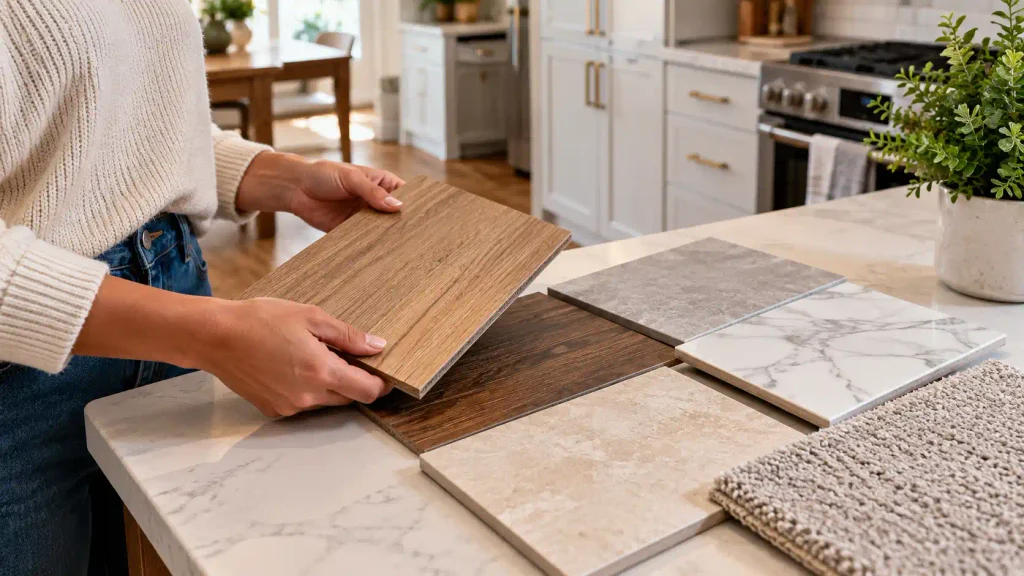
We sell and install hardwood, luxury vinyl, ceramic tile, laminate, and carpet. In a kitchen, the useful question isn’t which material wins overall. It’s which one matches the answers you gave above.
If you already have hardwood in the rooms next to your kitchen, we can help you explore whether continuing that look makes sense for your space. Oak hardwood is one of the floors we install, and continuing a wood floor into the kitchen can tie a main level together. Ask how it suits your cooking habits and what care it will need over time.
Luxury vinyl, including vinyl plank flooring, gives you the look of wood or stone with a different set of tradeoffs. It’s worth comparing side by side with hardwood if you like a wood look but want to talk through how each one would hold up to your household’s routine.
Ceramic tile is a natural fit for a kitchen where the floor and backsplash are being planned together. Coordinating the two from the start, rather than choosing one and then trying to match the other, usually produces a more finished result.
If you like the look of wood, laminate is another option we sell and install. We’ll help you compare it with other options based on how you use your kitchen and the surrounding rooms.
Keep it, repair it, refinish it, or replace it?
Not every kitchen needs a brand new floor. If the existing floor is in decent shape and your cabinets are staying, fixing what’s there may be the better move. Our flooring improvement work includes hardwood refinishing, tile repair, and vinyl replacement, and our renovation work includes full flooring replacement.
A few practical questions can help you decide. Is the floor’s problem cosmetic, or is it limited to a few damaged spots? Do you like the material and just dislike how it looks today? Is the kitchen part of a larger update where a new floor would make more sense? Your answers point toward a repair, a refinish, or a replacement, and we can walk through those options with you.
How the decision comes together with us
Our design consultation at Christian Flooring & More is built for exactly this kind of decision. It includes a space evaluation, material recommendations, cost estimates, and project timelines, and it covers flooring material consultation and kitchen design services. The aim is to start the project with a clear plan, so you aren’t making expensive choices on the fly.
We’ll start by discussing your goals and evaluating the space. Next, we’ll help you choose materials and finalize the design. Once the plan is ready, we’ll prepare a timeline, order materials, and schedule installation. After the work is completed, we’ll walk through the finished project with you. Our installers pay close attention to measurements, preparation, and finishing details, which matter most in a kitchen, where flooring runs up against cabinets, appliances, and transitions to other rooms.
Conclusion
The right kitchen floor comes from a few decisions made in the right order: whether the floor is its own project or part of a remodel, how your household really uses the room, and where the floor should stop. Once those are settled, choosing between hardwood, luxury vinyl, ceramic tile, and laminate gets much simpler.
If you’re weighing kitchen flooring in Rochester, visit Christian Flooring & More and bring your list of questions to either of our stores, at 4655 Ridge Rd W in Spencerport or 827 Ridge Road in Webster. Both are open Monday through Saturday, until 7 pm on Tuesdays and Thursdays. You can also call the Spencerport store at (585) 352-1170, email christianflooring@gmail.com, or reach us through our website to set up a design consultation.
FAQs
Can you install a new kitchen floor without remodeling the rest of the kitchen?
Yes. We provide flooring installation on its own, including hardwood, vinyl plank, tile, laminate, and carpet. If you later decide to take on more, we also do complete kitchen remodeling.
Does your design consultation cover flooring, or only cabinets and layout?
Flooring material consultation is part of it, right alongside kitchen design services.
My kitchen floor connects to two other rooms. Can you update them all together?
Yes. Our multi room upgrades handle work across several rooms at the same time, with the goal of a cohesive design throughout.
Some of my kitchen tiles are cracked. Do I have to replace the whole floor?
Not necessarily. Tile repair is part of our flooring improvement services, along with hardwood refinishing and vinyl replacement. We can look at your floor and talk through whether repair or replacement fits your situation.