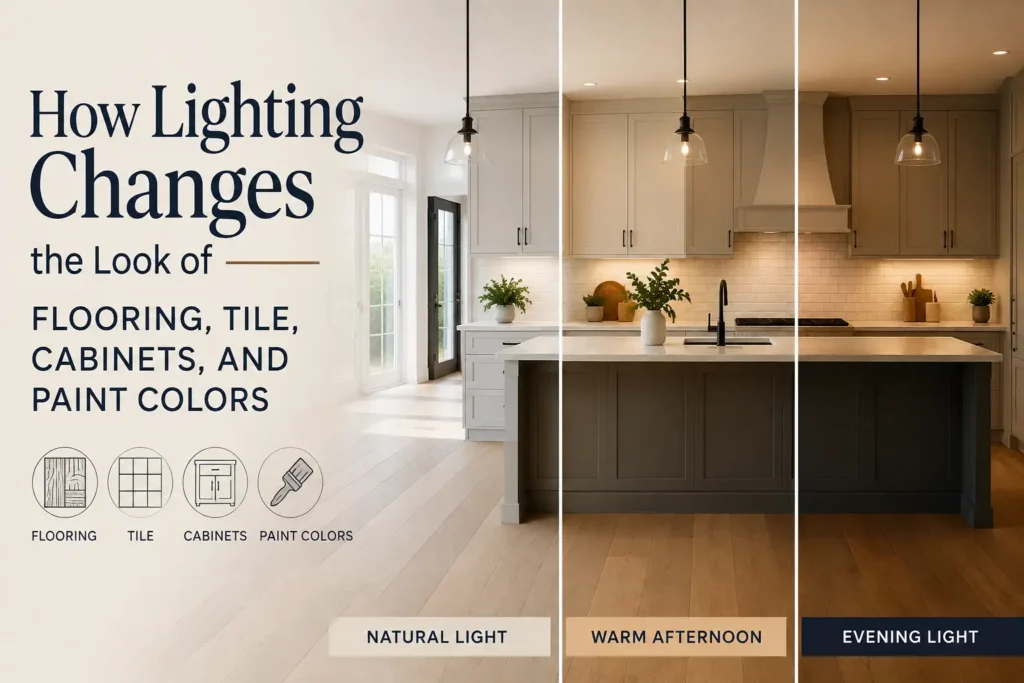
Lighting changes the look of flooring more than many homeowners expect, and the same effect applies to tile, cabinets, countertops, and paint. A finish that looks warm and balanced in a showroom can appear cooler, darker, brighter, or more muted once it is inside your home. That is why at Christian Flooring and More, material selection should be considered together with the room, surrounding finishes, and the lighting conditions where those materials will actually be seen.
Why Lighting Should Be Part of Your Material Selection
Color is not viewed in isolation. What you see depends partly on the light reaching the surface and the materials surrounding it.
A renovation may involve several large visual surfaces at once:
- Flooring
- Cabinets
- Tile
- Countertops
- Backsplashes
- Walls and paint
If each finish is selected separately, they may look coordinated under showroom lighting but interact differently once installed together.
Looking at materials as a group helps you understand the complete room rather than judging one sample at a time.
Natural Light Can Make the Same Material Look Different Throughout the Day
Natural light changes as the day progresses.
A room may receive stronger daylight during one part of the day and much less during another. The direction of the windows, surrounding structures, curtains, trees, and room layout can also affect how much natural light reaches the interior.
That means the flooring you like in the morning may appear somewhat different later in the afternoon.
This matters especially for large surfaces such as hardwood flooring or painted walls. Once installed, these materials occupy far more visual space than the small sample used during selection.
A flooring sample that appears moderately warm may create a stronger warm impression across an entire room. A darker material may also feel more visually dominant when it covers the full floor.
The goal is not to find a material that looks identical every hour. Lighting naturally changes. The goal is to understand those changes before making the final selection.
Artificial Lighting Changes Color After the Sun Goes Down
Your home is not viewed only in daylight.
In the evening, artificial lighting becomes the main source of illumination. Different bulbs and fixtures can create noticeably different impressions of the same finishes.
Warmer lighting can emphasize warm tones already present in wood, cabinetry, tile, or paint. Cooler lighting can make those same surfaces appear less warm and may make cooler undertones easier to notice.
This becomes important if your renovation combines several materials.
Imagine a kitchen with:
- Wood tone flooring
- Painted cabinets
- A stone or quartz countertop
- Tile backsplash
- Painted walls
Each surface reflects light differently. A combination that feels balanced in daylight can look different once the kitchen lighting is turned on at night.
For that reason, material selection should consider how you actually use the room, including the hours when artificial lighting will be most important.

Flooring Can Look Lighter, Darker, Warmer, or Cooler
Flooring creates one of the largest continuous surfaces in a room, so even a subtle color change can influence the overall appearance.
Hardwood, luxury vinyl, laminate, tile, and carpet can all respond visually to changes in lighting.
Wood look flooring deserves particular attention because its appearance can include several tones at the same time. One plank may contain lighter areas, darker grain, and warm or cool undertones.
Under one type of light, the dominant impression may come from the lighter sections. Under another, the darker or warmer parts may become more noticeable.
This is why choosing flooring based only on a small sample can be difficult.
Christian Flooring and More offers flooring options including hardwood, luxury vinyl, ceramic tile, laminate, and carpet, and its design process includes helping homeowners evaluate finishes and materials based on their needs and preferences.
Tile Can Change Because of Color, Finish, and Reflection
Tile adds another variable because its surface may interact with light differently depending on the finish.
A reflective tile can respond strongly to direct light, while a less reflective surface may appear more consistent.
The amount of light matters too.
A lighter bathroom tile can appear bright in strong daylight but more subdued under evening lighting. Darker tile may create more contrast, particularly next to a light vanity, wall, or countertop.
Grout also becomes part of what you see.
When the grout color is close to the tile color, the surface may read more continuously. Stronger contrast between grout and tile can make the individual tile pattern more visually obvious.
During a bathroom renovation, it therefore helps to look beyond the tile itself and consider the tile, grout, vanity, flooring, fixtures, and lighting as one design group.
Cabinet Colors Can Reveal Undertones You Did Not Notice in a Small Sample
Cabinets occupy a large vertical area in a kitchen.
That makes their color especially influential.
A white cabinet is not always simply “white.” Depending on the finish, it may visually lean warmer or cooler. The same is true for beige, gray, cream, wood tones, and other cabinet colors.
Lighting can make those undertones easier to notice.
This becomes particularly important when the cabinets sit next to another large surface.
For example, you may be combining:
Cabinets + countertop + backsplash + flooring + wall paint
The relationship between these finishes matters more than the isolated appearance of any one sample.
A cabinet that appears neutral on its own may seem warmer once placed beside a cooler countertop. Change the lighting, and that relationship may become even more noticeable.
That is one reason Christian Flooring and More’s kitchen remodeling process considers cabinetry, countertops, space planning, finishes, workflow, materials, and budget together rather than treating each decision independently.
Paint Color Is Especially Sensitive to the Surrounding Room
Paint covers a large area and is affected by almost everything around it.
The same wall color can appear different next to:
- Dark flooring
- Light flooring
- Warm wood cabinets
- Cool cabinets
- Colorful tile
- Neutral tile
This happens because homeowners do not experience the wall color by itself.
You see the whole room simultaneously.
For example, a neutral wall beside warm hardwood may create a different overall impression than the same wall color beside cool gray tile.
The room’s light conditions add another layer.
This is why choosing paint before flooring, cabinets, tile, and other major finishes are understood can make coordination harder.
Room Direction and Window Placement Matter
Two rooms in the same home do not necessarily present colors the same way.
A room with large windows and strong daylight may make surfaces appear brighter. A hallway, powder room, or interior room with little natural light depends much more heavily on artificial lighting.
You should therefore avoid assuming that a flooring or paint combination that works in one room will look exactly the same in another.
This becomes especially important during a multi room renovation.
You may want the flooring or paint palette to connect several areas visually, but each room can have different lighting conditions.
The design goal should be coordination rather than forcing every room to appear identical.
Look at Samples Together, Not One at a Time
One of the simplest ways to make better material decisions is to compare related finishes together.
If you are renovating a kitchen, review the flooring with the cabinet, countertop, backsplash, and paint direction in mind.
For a bathroom, compare tile with the vanity, flooring, fixtures, and wall finishes.
For flooring throughout several rooms, think about how the floor interacts with existing or planned wall colors, cabinetry, furniture, and natural light.
A useful comparison sequence is:
Room lighting → flooring → cabinets or major fixtures → tile or countertops → paint and supporting finishes
This keeps the major visual surfaces connected.
Christian Flooring and More’s published renovation process starts with discussing the homeowner’s vision, needs, and budget, followed by design and material selection before detailed planning and installation.
View Important Samples in the Actual Space When Possible
Showroom displays are useful for comparing products, but your home has its own lighting environment.
If you are making an important color decision, viewing the relevant sample in the room can provide additional context.
Look at it during more than one part of the day if practical.
Ask:
Does the flooring still work with the cabinets in evening light?
Does the tile become much darker when natural light decreases?
Does the cabinet finish reveal a warm undertone beside the countertop?
Does the paint still coordinate with the flooring?
You are not looking for a finish that never changes. You are checking whether you still like the overall combination as the lighting changes.
Why a Design Consultation Helps With Color Coordination
A design consultation gives you an opportunity to evaluate these decisions as one connected renovation rather than as separate purchases.
Christian Flooring and More’s consultation process includes discussing goals, evaluating the space, taking measurements, and presenting material options that fit the homeowner’s style and project requirements.
That process matters because a flooring choice can affect cabinet selection. Cabinets can influence countertop and backsplash decisions. Those finishes then affect how paint colors are perceived.
The decisions form a chain.
Thinking about lighting during material selection helps you see that chain earlier, before the finishes cover entire floors, walls, or cabinet runs.
Frequently Asked Questions
Why does my flooring look different at home than it did in the showroom?
Your home has different natural light, artificial lighting, surrounding colors, room dimensions, and furnishings. These conditions can change which tones in the flooring appear most noticeable.
Can lighting make flooring look darker?
Yes. Flooring may appear darker in areas with less available light, while strong natural or artificial light can make the same surface appear brighter and reveal more variation.
Should I choose flooring or paint color first?
For a larger renovation, it often makes sense to establish major fixed finishes such as flooring, cabinetry, tile, and countertops before finalizing supporting paint colors. The exact sequence depends on the project.
Can the same cabinet color look different in two kitchens?
Yes. Natural light, artificial lighting, surrounding materials, wall colors, countertops, and flooring can all influence how the cabinet color is perceived.
Should I bring paint colors to a flooring design consultation?
If you already have paint colors or other finishes you intend to keep, bringing that information can help evaluate how new flooring or renovation materials may work with the existing room.
Choose Materials as Part of the Whole Room
Lighting changes the look of flooring, but flooring is only one piece of the visual relationship inside a renovated space. Tile, cabinets, countertops, walls, and paint all respond to the same light while also affecting how the other materials are perceived.
At Christian Flooring and More, we help homeowners look at renovation materials as connected decisions. If you are planning new flooring, a kitchen, a bathroom, or a larger home renovation in the Rochester area, a design consultation can help you compare the materials, finishes, and room conditions before those choices become permanent parts of your home.